
It seems like every skincare nowadays advertises that it has AHAs and BHAs. So what are they? And do you really need them in your skincare?
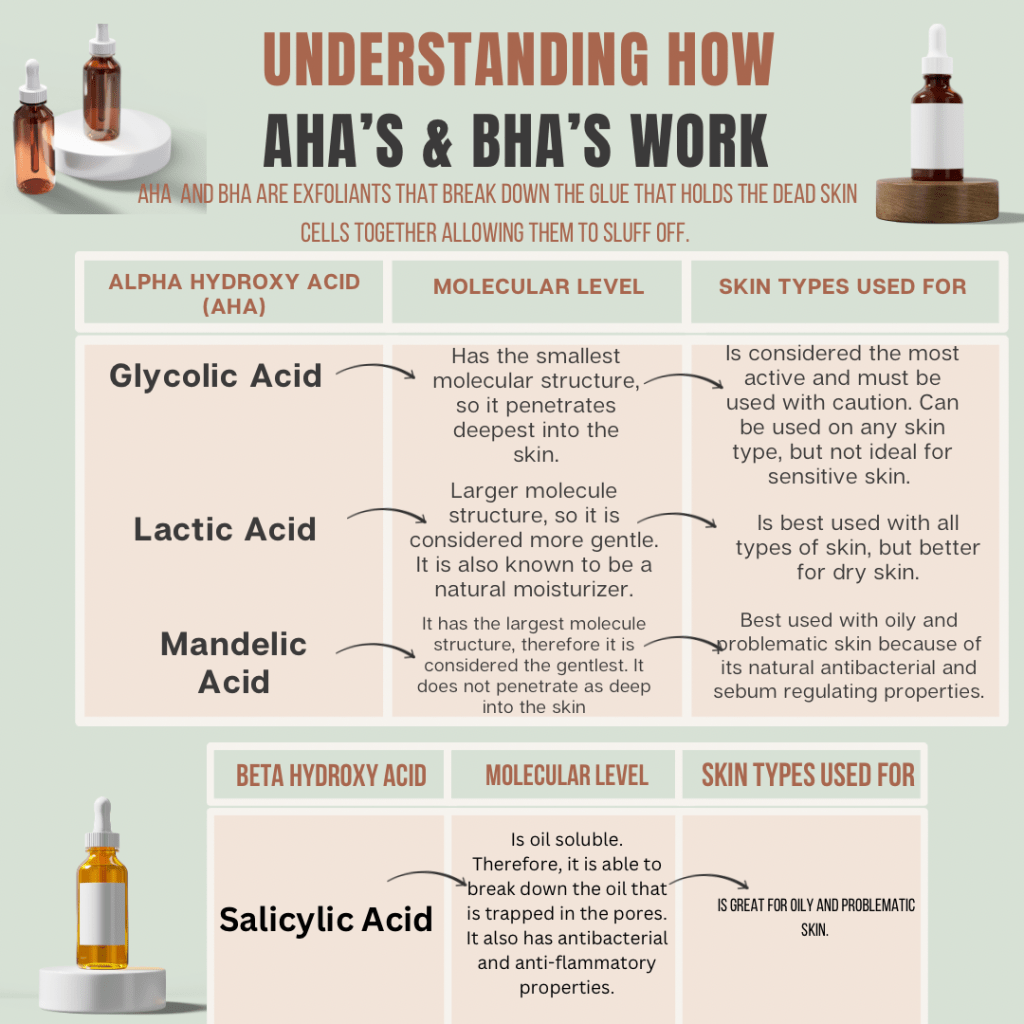
BASICALLY, AHAs are a water soluble acid. They are naturally occurring acids that are found in fruit, nuts, milk and sugar. Some examples would be glycolic acid, lactic acid and mandelic acid. These acids work by dissolving the ‘glue’ that holds the dead skin cells together. Once, this glue is dissolved, it allows the dead skin cells to slough off. This allows for a faster cell turnover, which reveals a brighter more youthful skin underneath.
Some AHAs are stronger and go deeper into the skin. For example Glycolic acid is generally considered the strongest acid, because it has the smallest molecular level and has the ability to penetrate deepest into the skin. Glycolic acid is a highly effective way to brighten and exfoliate the skin. Products with a high concentration of glycolic acid need to be used with caution especially on very sensitive skin or thin skin. Lactic acid, has a larger molecular structure, which means it doesn’t go as deep into the skin so it is gentler and potentially less irritating. Lactic acid is known to increase natural moisturizer and the epidermal barrier lipids within the skin, it also has lightening benefits for those with discoloration. Mandelic acid has the largest molecular structure, so it is considered gentle. It is known to improve overall skin tone and texture. It also is said to help oily and problematic skin due to the fact that it has natural antibacterial and sebum-regulating properties.
Now let’s talk about BHAs. They work the same as AHAs. They dissolve the ‘glue’ that holds the dead skin cells together so they can slough off. The difference between the two are that BHAs are oil soluble. So that means they target the oil on your skin. Salicylic Acid is the most common BHA. BHAs are really good to use with oily skin types. However if you have dry skin, you may want to avoid salicylic acid. The fact that you have acne, does not necessarily mean you have oily skin. To understand acne better, please refer to my article Skincare for Acne, What Actually Helps?
AHAs and BHAs are a great way to exfoliate the skin, which can help with hyperpigmentation, acne and anti-aging. The potency of these products definitely depends on the concentration. The more highly concentrated a product is, the more results you’ll see; however that can also mean that if it has a higher concentration it can be more irritating to your skin. If you are thinking of purchasing one of these products to add to your skincare, always start with a low concentration and build you way up to a higher concentration.

 Glow by Jo Skin Studio